
The Quriiri has been updated with the latest SMS blocking feature. The blocking list makes it easier for our customers to do the right thing, as in Finland, the law requires that every direct marketing message must be able to be blocked easily and without any extra charge.
In this article, we explain what you should consider if you are doing SMS marketing and why you need an estoppel (we are not legal experts, however, so we always recommend you check the details with your law firm.)
What is direct marketing?
Electronic direct marketing means direct marketing by means of automated calling systems, faxes, email, text, voice or picture messages (Office of the Data Protection Ombudsman). The aim of direct marketing is usually to attract customers to buy products or services or to persuade them to take a particular action. Typical SMS marketing messages include special offers, discounts, coupons or personalised offers.
Email direct marketing can be an effective way to reach a target audience in a direct and personalised way, but its effectiveness depends on many factors, such as the relevance of the message and the interest of the target audience.
Permission required for direct marketing by electronic means
To send marketing text messages to customers, you need the recipient's consent. As the controller, you must be able to demonstrate that the data subject has given consent to the processing of personal data for the purposes of electronic direct marketing. The consumer must be able to indicate by their own action their consent to receive electronic marketing messages. This can be, for example, a checkbox, which is empty by default. A ticked box does not imply consent.
For SMS marketing, you can also set up a keyword that, when sent to the company number, will join the SMS list. If a customer sends a keyword, e.g. ”CLUB” to the company number, they have opted in to receive messages from the company.
However, there are certain cases where permission is not required to send direct marketing by SMS. If the contact information was obtained in connection with the sale of a product or service and the message only promotes similar or identical products or services to those sold by the business in a previous transaction, marketing is allowed. However, the consumer must have been informed about the sending of marketing messages in the context of the transaction and must have the possibility to opt-out of the sending of such messages in each communication.
B-to-B direct marketing
B-to-B direct marketing can be done more freely than direct marketing to consumers. The customer's consent is not required when the recipient is a company or organisation, i.e. when the message is sent to the company's public number. If the recipient is a natural person, for example an employee of the company, the products or services being marketed must be related to the employee's duties. In this case too, the text message must clearly state that it is possible to opt out of the use of contact details.
The possibility to opt-out of marketing messages
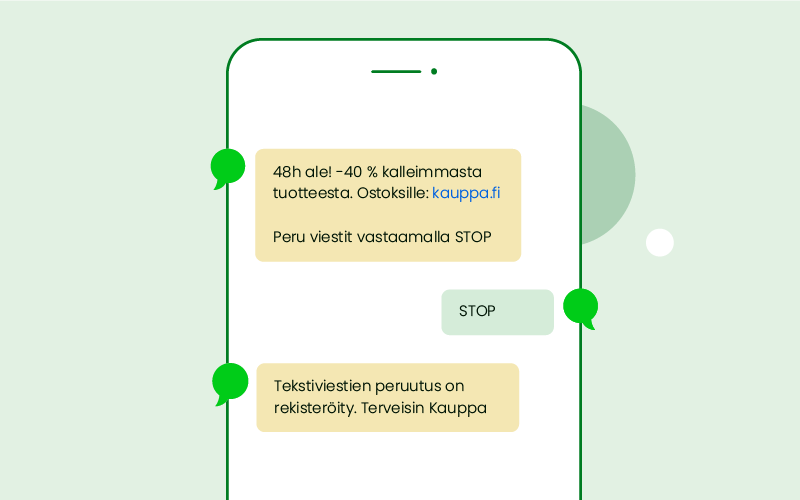
The recipient of text message marketing must be able to opt-out of receiving marketing messages at any time and must be informed of this in each message. This can easily be included in text messages, for example by allowing the recipient to reply to the message with a keyword such as ”STOP”. The use of personal data and the possibility to unsubscribe should be explained as openly and clearly as possible, in order to build customer trust in the company.
Quriirin barrier list feature
The new blocklist feature makes it easy for Quriirin customers to add the option to ban SMS messages in the future.
The block list is used to prevent SMS messages from being sent to contacts on the list. Contacts can be added to the block list in the following ways:
1) By setting message-blocking keywords in the recipient numbers. The contact who sent the keyword to the number will automatically be added to the block list.
2) Adding contacts that have blocked messages manually by importing a file containing contacts (.xls, .xlsx or .csv) or by adding individual phone numbers.
See instructions for using the blocklist here.
Ways to communicate the possibility of blocking
The possibility to unsubscribe should be made as clear as possible. Here are some examples of how you can tell recipients:
- Cancel your order by replying to PERU
- If you want to stop receiving our SMS messages, reply to STOP
- If you do not wish to receive further messages, please send PERU to 18533
- Don't want messages? Send STOP to 18533
- If you do not wish to receive further messages, please send an ESTO to 18533. The message is free of charge
Text message marketing is familiar to consumers and most marketers use a similar way of communicating the blocking, so consumers know what to expect. If you need help or have questions about the blocking list, contact us - we will help you.