
Many companies still send messages manually: same message for everyone, same channel, same rhythm. At the same time, customer expectations have changed radically. They want to be treated as individuals: at the right time, in the right channel and with the right tone.
Bloomberg article The Customer Trust Mandate - Leading the New Era in Communications we have entered an era where the main currency of communication is trust. The way a company communicates largely determines whether a customer perceives it as trustworthy and relevant.
But how many companies actually communicate in a way that redeems that trust?
The old way of messaging no longer works
Until a few years ago, “one message for all” worked. Now it feels trite and distant.
Companies that continue with generic mass communication are slowly losing the attention - and trust - of their customers.
The problem is not the desire to communicate better, but the way you communicate:
- One message for all
- Without data or context
- Without understanding the customer's situation
The result is a flood of messages where none of them feel important.
Trust starts with accuracy
Today's customers are precise: they want messages to be relevant, honest and transparent. Research shows that more than half of consumers want personalised messages, but few trust companies to use their data responsibly.
So trust is not automatic, it has to be earned. And communication plays a key role in that.
Trust-building communication is:
- Personalised: the message identifies the customer's situation
- Authentic: the tone is human and sincere
- News: the message comes when it's really useful
This kind of communication does not require a big investment in systems - it can be done with smaller tools, once the groundwork is in place.

Personalisation can also be done without automation
Not all companies have multi-channel automation systems in place, nor do they need to. With Quriiri, you can personalise messages effectively even when communication is done manually.
Quriiri can import a wide range of customer data, such as location, purchase history, contract type or individual careers, and use it in the content of messages. This enables messages that feel personal and relevant, even when sent to multiple recipients at the same time.
For example:
- online shop can target messages to a specific customer segment and include personalised links
- electricity company can send a message to customers in the event of a power cut, adapting the message to the customer's address, date and time.
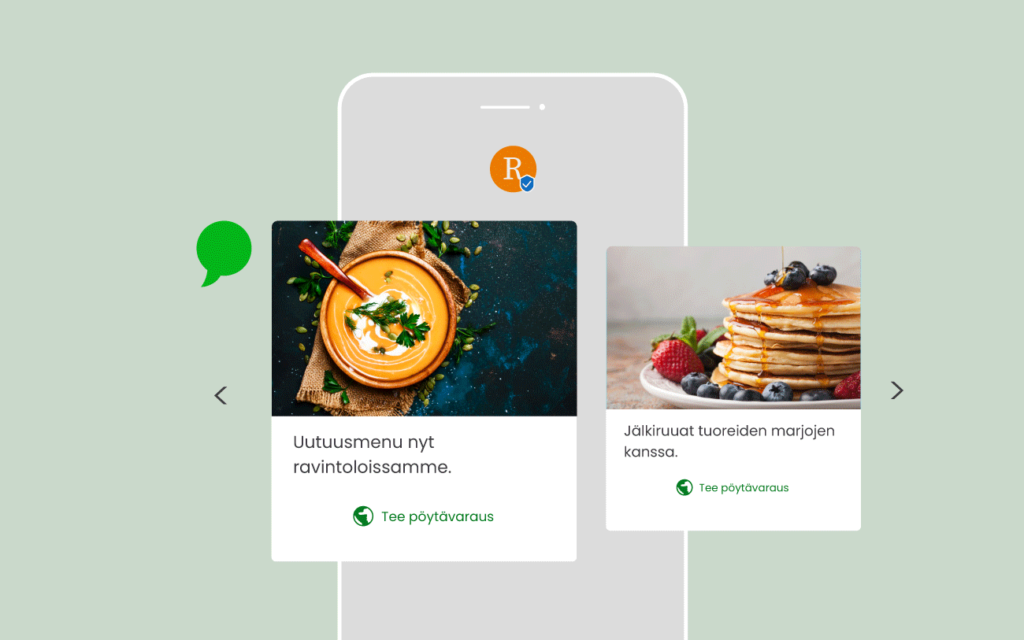
- restaurant can communicate different offers to regular customers than to new customers
- or after-sales service can remind customers when they need to be serviced, based on their equipment or service details.
So even small businesses have the opportunity to create messages that feel personal when they have a tool that supports personalisation easily.

Try automation lightly
Automation makes communication more efficient and can also improve the customer experience. Automation can also be done easily and without coding. Zapierin tools such as the Quriiri can connect to other systems in use - such as e-commerce, CRM or customer registers - and automatically trigger a message on specific events.
For example, a new order, customer service request or payment reminder can trigger a personalised message automatically, without coding or heavy integration.
This allows your business to benefit from automation in an easy and cost-effective way. Quriiri gets the message to the right recipient, at the right time.
Hyperpersonalisation goes further
For larger organisations, personalisation can evolve to the next level: for hyper-personalisation. In this case, the communication automatically adapts to the customer's behaviour and the time of day, e.g. CCM (Customer Communications Management) systems with the help of.
When Quriiri is integrated into such systems, personalised SMS and RCS messages are automatically sent to the right recipient, at the right time and with the right content. In this way, Quriiri works as part of a broader communication system that combines the best of automation and human communication.
But in the end, both manual and automated personalisation aim at the same thing:
communication that feels meaningful to the customer.

AI is a great help, but not a replacement for humans
Over the next few years, customer trust and attention will be won in milliseconds and this is where AI can help. Especially if AI is used to interpret real-time data and turn this information into meaningful messages for the customer.
But AI is not an automatic solution. At best, it strengthen the human connection, helps businesses identify customer needs before they even ask and ensures that communication is fast, accurate and secure. But without relevant, empathetic content, the message can go horribly wrong. The future of communication will be built on a partnership between AI and humans: AI analyses, predicts and optimises - humans maintain empathy and understanding.
Communication platforms such as Quriiri are already enabling this collaboration. When AI and Quriirin communication channels, such as SMS and RCS messages, connected to company systems, messages can be automatically adapted to the situation, the customer and the context.
The result is communication that keeps the customer interested and happy - in the right channel, at the right time, every time.
Balancing data and privacy
When communication is based on data, it also raises questions of responsibility. Where does the data come from? How is it used? Has the customer given permission?
Responsible communication is not just about data protection. It is reputation management and trust management. If a customer feels that a company is using their data carefully and in their best interests, they will reward this with commitment. If, on the other hand, data is misused, trust is lost in an instant.
How to build a competitive advantage in communications
The change towards more relevant communication starts with small steps. Here are six concrete ways to get started, without heavy systemic reform:
- 1. Map the current situation - where is the communication generic or repetitive?
- 2. Make use of existing data - Quriirin allows you to easily import a wide range of customer information into your messages.
- 3. Segment and experiment - test how different groups react to different tones and content.
- 4. Plan right - message when it is relevant to the customer, not according to the company's calendar.
- 5. Measure the results - tracks responses, website traffic and conversions (Read more about measurement)
- 6. Ask for feedback - customers are happy to tell you which messages they find useful and which they don't.
Communication reform is an investment in the customer
Developing communication is not just a technical project. It's an investment in how your customers experience your brand. At Quriiri, we believe that advanced communication belongs to all businesses, not just the big players. When communication is personalised, timely and trustworthy, it works and feels authentic.
Is your communication still “one size fits all”?
Perhaps now is a good time to stop and think about how your messages could better serve your customers.
Communication that is personalised and relevant to the customer is communication that builds trust.
Written by Tanja Lipponen, Marketing Manager at Quriiri, who has long experience in marketing and communications and brand building. Tanja helps companies to take advantage of Quriiri's communication services.