
The first SMS was sent almost 30 years ago on 3 December 1992 in the UK and this traditional channel still plays a strong role in business communication. According to Quriiri statistics, the number of messages sent by businesses has increased by around 30% per year in recent years.
The format of the text message has remained largely unchanged since the first message. It uses the GSM network and is 160 characters long. Today, SMS is used in particular by businesses. Why is this the case? We asked Quriiri's Business Director From Lasse Lohikoskel, who has a long experience in mobile corporate communications.
”The strengths of text messaging are definitely reachability, certainty and speed. Text messages are sure to reach anyone with a mobile phone. No other communication channel can still do the same. Technology also allows SMS to be integrated into a company's own systems, often becoming an automatic part of customer communications.”, says Lasse.
Number of business SMS messages still on the rise
The first text message read ”Merry Christmas”. Today, corporate messages typically read ”Hi, your order 123456 is available for pick-up in our store”, ”Please remember your dental appointment today at 1pm” or ”Your verification code is 654321”.
According to Quriiri statistics, the number of SMS messages sent by businesses has increased by around 30% per year. Quriiri technology is already used to send more than 200 million SMS messages per year.
”The number of SMS messages sent by businesses has grown rapidly in recent years. The pandemic has given a further boost to digitalisation and SMS has a strong role to play in this development. For example, online sales grew rapidly during the pandemic, which also contributed to the growth of the A2P (application-to-person) SMS market and is expected to continue to grow.”, says Lasse.
What is SMS used for?
Businesses send SMS benefit messages, such as reminders, confirmation messages and pick-up notifications. This winter, electricity companies are prepared to send SMS messages to customers about possible power cuts. Text messaging is particularly well suited to crisis communication, as it is a quick and reliable way to reach customers.
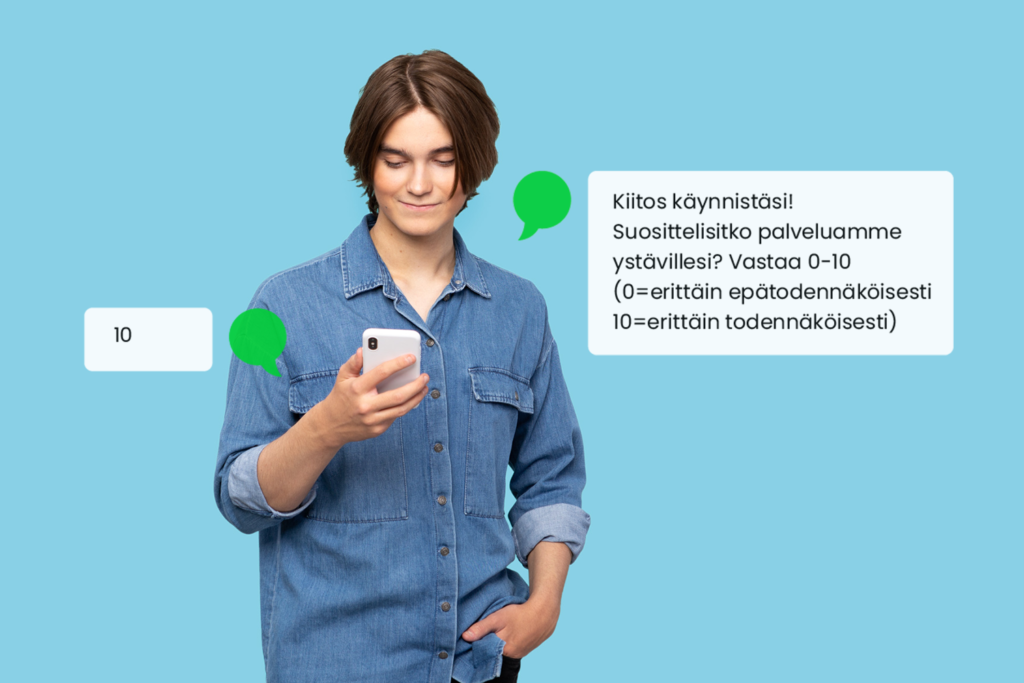
In addition to benefit messages, companies are also increasingly sending PINs, marketing messages and SMS surveys. Lasse predicts that the importance of two-way communication in particular will also increase in the SMS channel. This means that the customer will be able to reply to a message sent by the company. This means, for example, that a customer can accept an appointment or a payment directly via SMS.
”SMS is an easy and quick way for consumers to respond. For example, our customers have a very high response rate to feedback and satisfaction surveys.”, says Lasse.
Quriiri has a good growth rate
Quriiri is developed by NextUp Oy, a software company whose steady growth rate also reflects the popularity of SMS.
”We have been successful in serving our customers' needs and we constantly strive to improve our service in line with their wishes and feedback. We focus on service quality and reliability, so that our customers can reliably send large volumes of messages. We also keep a close eye on developments in the sector”, says Lasse.
There is currently much discussion about the advent of RCS (Rich Communication Services), which has been presented as a natural successor to SMS. At Quriiri, it is believed that it will replace SMS as a form of communication that allows a more visual and richer way of communicating with customers. RCS is already in use in some countries, but Finnish operators have not yet announced a timetable for the introduction of RCS in Finland.
Would you like to learn more about how SMS could fit your business? Contact us or kokeile for free!